
Significant price differences when travelling by ferry with a campervan
Ferry travel with a campervan opens up completely new possibilities for holiday planning. They open up destinations that cannot be reached by land and easily extend routes with extra stages. Especially on camping trips, combining your own vehicle with a ferry crossing offers the opportunity to be independent and flexible, even at distant destinations.
But which ferry routes are particularly well suited for travelling with a campervan? Which connections are the fastest? And how much does a ferry journey cost on average?
Here is an overview of the most important findings:
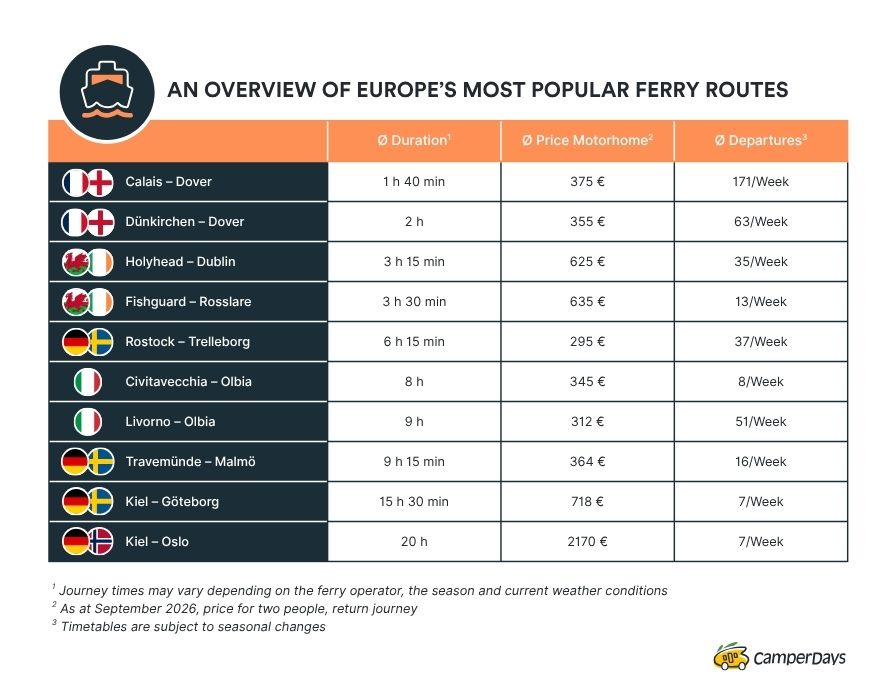
Short routes are usually cheaper and more flexible: Connections like Calais – Dover or Dunkirk – Dover offer comparatively low ticket prices and multiple departures per day.
Long crossings are significantly more expensive: On long routes such as Kiel – Oslo or Kiel – Gothenburg, the ferry journey is considerably more expensive; costs for a cabin and, if applicable, meals on board are also added here.
Booking early pays off: Anyone who compares several departure ports and departure times, and looks at the total price including a cabin and additional services for long routes, can estimate the costs better.
It is not just the ticket price that counts: Whether taking a ferry with a campervan is worthwhile also depends on the chosen travel period, the number of travellers and the size of the vehicle. Travellers should always weigh up whether they prefer shorter ferry journeys with a longer drive overland, or longer but direct ferry connections.
For the "Europe Ferry Price Report 2026", we investigated the most popular ferry connections for campervan trips and compared prices, travel times and availability. The focus is on routes from Germany to Sweden and Norway, connections between France and England, routes between Wales and Ireland, and crossings from mainland Italy to Sardinia.
The aim of the study is not to identify a single, particularly cheap ferry fare. Rather, we want to show what costs campervan travellers should expect on the most popular European ferry connections and which routes are most suitable under which conditions.
To determine the prices, we analysed current data from ferry price databases. These figures are based on recent price queries* and therefore represent market averages rather than binding fixed prices. The actual prices payable may vary depending on the vehicle type, vehicle length, number of passengers, travel date, departure time and booking time. To calculate the average values, we used the following travel scenario: Two adults travelling in a medium-sized campervan (maximum 8 metres long, maximum 4 metres high) and booking a return trip.
*As of: September 2026
You can find more information about our database and methodology at the end of this report.
Why travel by ferry with your campervan?
Sometimes taking a ferry is the only way to reach certain destinations directly with a campervan. Depending on the destination, travellers can also use a ferry crossing to add further stopovers to their planned route and explore new regions. For campers, taking a ferry also has a practical advantage: your own or rented vehicle and your familiar camping equipment travel with you. Upon arrival, you can continue your journey straight away without having to book another campervan, transport luggage or pack again.
Jeanette, Customer Service (CamperDays): "What we see time and again in customer service is that many customers like to rent their campervan directly in Germany because the prices here are usually much more attractive than directly in Scandinavia. If you cleverly combine this with a cheap ferry connection, you will simply have a much more relaxed holiday budget in the end. It's always really nice for us to hear on the phone that they can then use the money they've saved for great experiences along the way, special campsites and their actual trip."
A ferry trip can also be particularly pleasant for families if the journey itself is to become part of the holiday experience. Instead of sitting in cramped rows of seats or in the car for the entire journey, children and parents can move around on board, use play areas, eat together or explore the outer decks. On longer routes and night ferries, family or multi-berth cabins also offer a private retreat for sleeping and relaxing.
Ferry travel from Germany to Sweden
Sweden is particularly popular with camping holidaymakers because of its vast natural landscapes. Long coastlines, numerous lakes, large nature reserves and well-developed camping facilities make it particularly attractive for road trips. At the same time, the trip can be wonderfully combined with stays in cities like Stockholm, Gothenburg or Malmö.
Rostock – Trelleborg
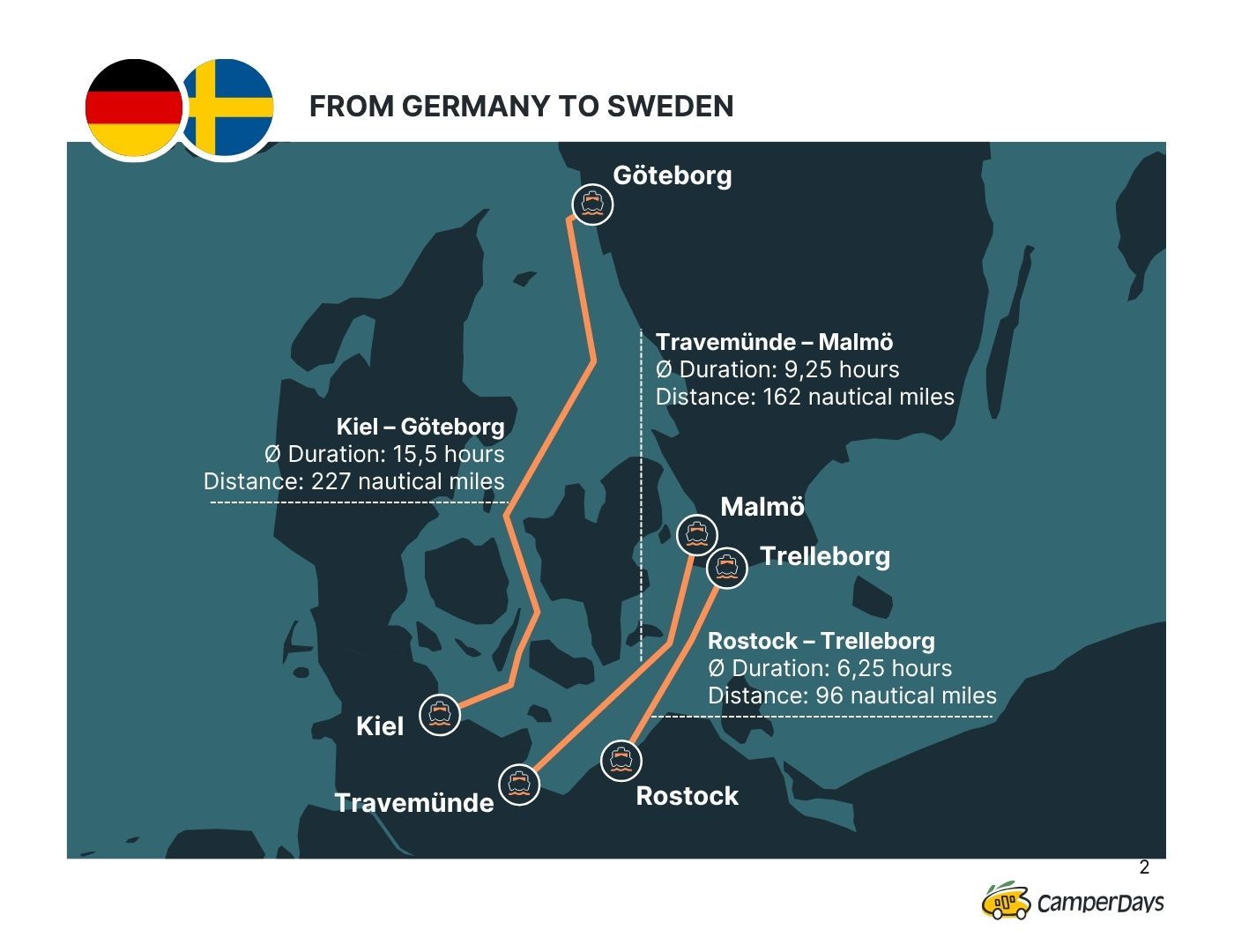
The connection from Rostock to Trelleborg is one of the shortest direct ferry links between Germany and Sweden and runs several times a day. The crossing takes around six hours. Trelleborg is the southernmost town in Sweden, making it an ideal starting point for travelling through southern Sweden.
Travel time: approx. 6 hours 15 minutes
Average departures: up to 38 weekly crossings
Average campervan price (return trip, 2 people): € 295
Depending on the departure time, the route can be travelled during the day or overnight. For daytime crossings, a cabin is usually not required.
Travemünde – Malmö
The ferry connection from Travemünde to Malmö leads directly to the Swedish Øresund region. The crossing takes about nine hours, making it particularly suitable for travellers who have chosen southern Sweden or the region around Malmö as the starting point for their campervan trip.
Travel time: approx. 9 hours
Average departures: up to 18 weekly crossings
Average campervan price (return trip, 2 people): € 364
Several ferries operate daily on this route. Depending on the departure time, the crossing can be made as a day or night trip. For night crossings, a cabin is required for the overnight stay.
Kiel – Gothenburg
The connection from Kiel to Gothenburg is particularly interesting for campervan travellers wanting to explore western Sweden. The ferry departs daily and takes around 16 hours for the crossing.
Travel time: approx. 15 hours 30 minutes
Average departures: up to 7 weekly crossings
Average campervan price (return trip, 2 people): € 718
Due to the longer travel time, it is necessary to book a cabin for this crossing.
Ferry travel from Germany to Norway
Norway is a particularly popular destination for campervan trips when varied scenic routes are the main focus. Fjords, mountains and waterfalls dominate the landscape and are best explored on the many panoramic roads.
Kiel – Oslo
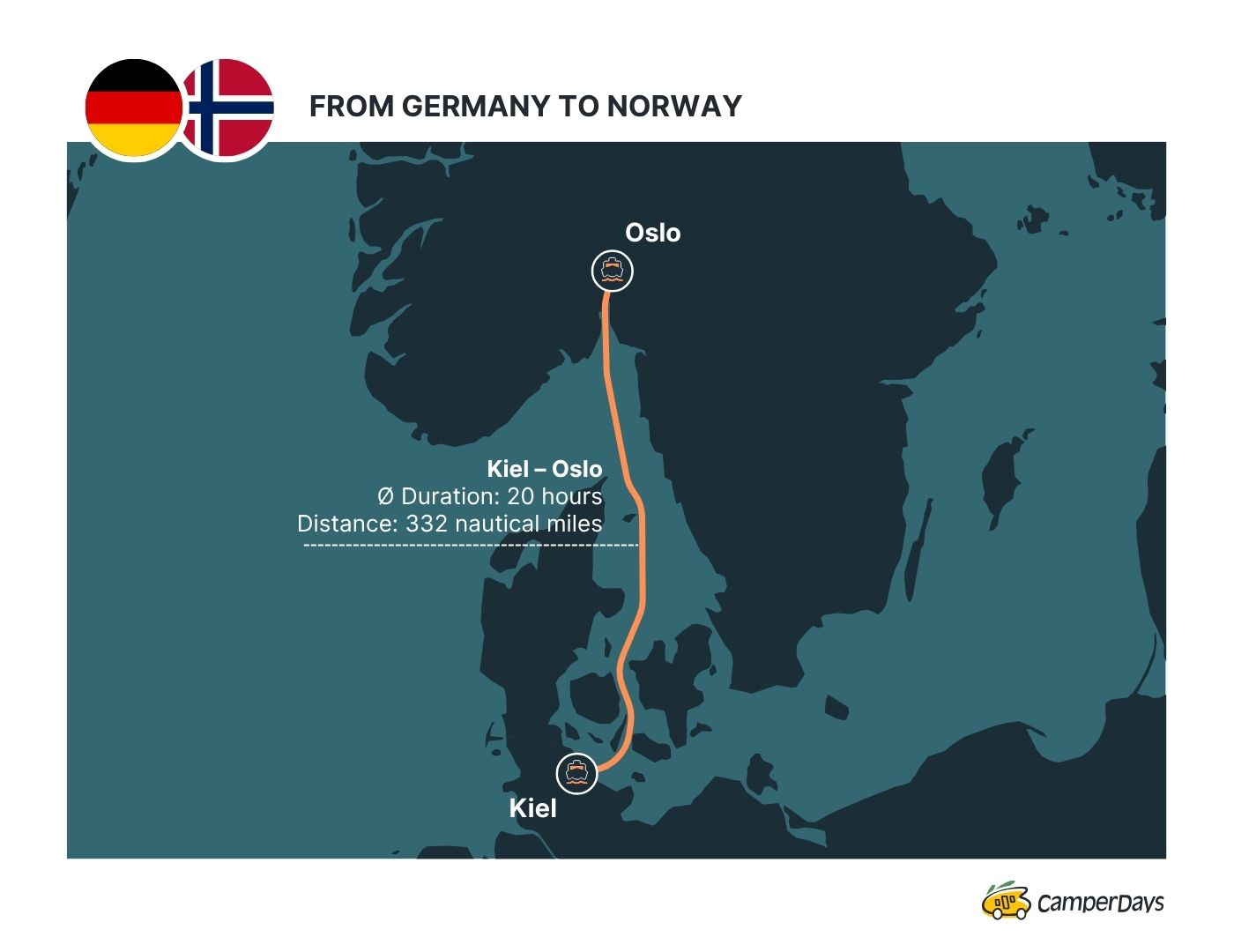
There is a direct ferry connection between Germany and Norway – from Kiel to Oslo. The crossing takes around 20 hours and operates as an overnight service.
Travel time: approx. 20 hours
Average departures: up to 7 weekly crossings
Average campervan price (return trip, 2 people): € 2,170
The route is especially interesting for travellers who want to reach Norway directly via a comfortable sea passage. Due to the long crossing time, the ferries always travel overnight, which is why booking a cabin is mandatory for all passengers.
Ferry travel between mainland Italy and Sardinia
A crossing to Sardinia offers the opportunity to extend your campervan trip through Italy with further stages. Varied Mediterranean landscapes and picturesque sandy beaches await campers on the island.
Holidaymakers can start a round trip of Sardinia in Olbia in the north, for example, and then travel to the east of the island to the Gulf of Orosei or the Gennargentu National Park. In the south, the island's capital Cagliari is waiting to be discovered.
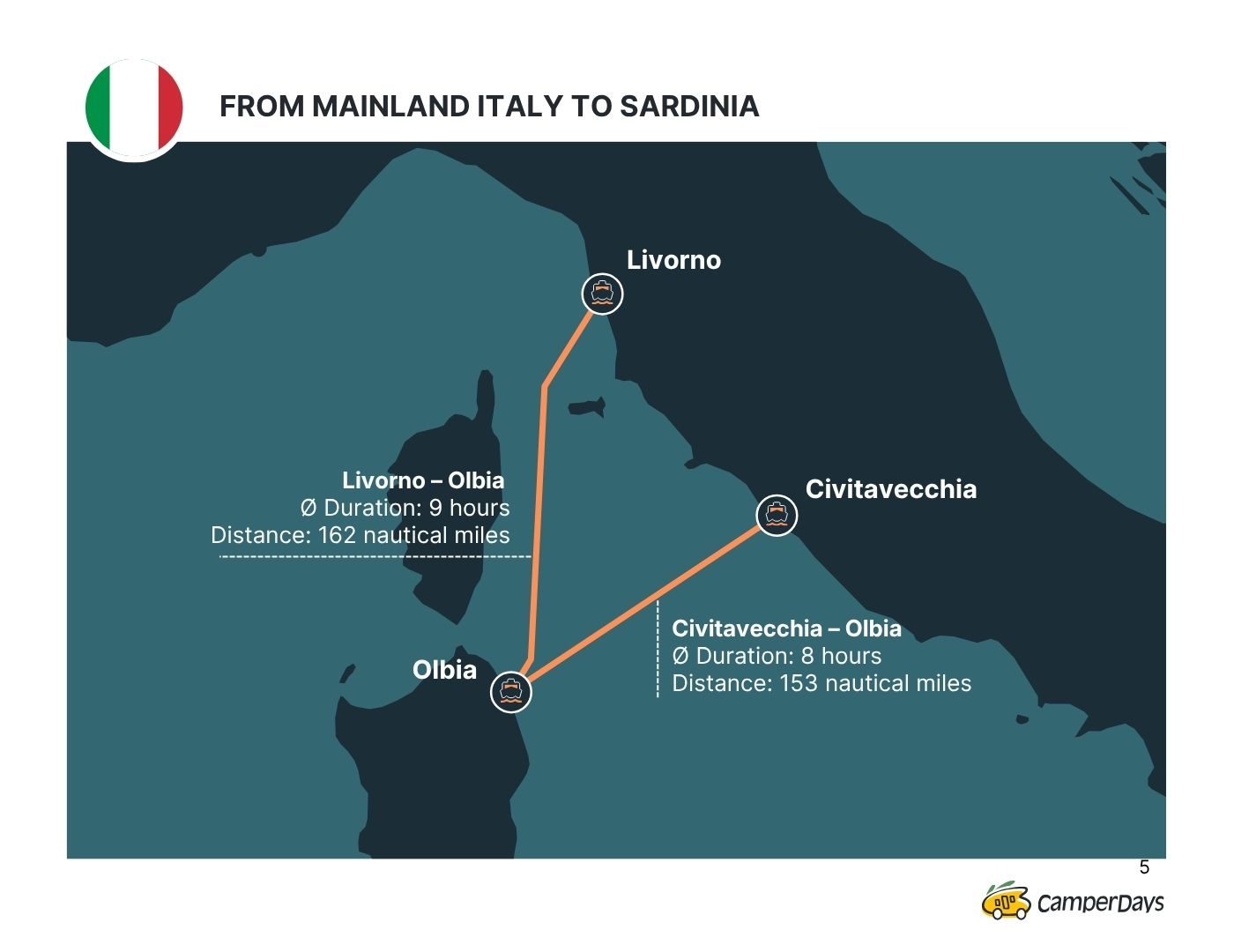
Livorno – Olbia
The Livorno – Olbia connection is a great way to reach Sardinia with your own campervan from mainland Italy. The crossing takes an average of around nine hours; depending on the season, the ferries run several times a week.
Travel time: approx. 9 hours
Average departures: up to 22 weekly crossings
Average campervan price (return trip, 2 people): € 312
The route is highly recommended for campervan travellers who first want to travel around Northern Italy or Tuscany and then include Sardinia as a separate part of their camping trip.
Rome (Civitavecchia) – Olbia
The ferry route between Civitavecchia and Olbia provides a direct connection between Sardinia and the metropolis of Rome. The crossing takes just under eight hours.
Travel time: approx. 7 hours 40 minutes
Average departures: up to 8 weekly crossings
Average campervan price (return trip, 2 people): € 345
Civitavecchia – Olbia is particularly interesting for travellers who want to explore Rome before their crossing to Sardinia. The crossing is slightly shorter than the ferry trip from Livorno. Which starting point is best suited for the crossing to Sardinia therefore depends on what stopovers are planned during the trip to Italy.
Ferry travel between France and England
For campervan travellers, the English Channel is one of the most important ferry connections in Europe. The short crossings from France to England make it possible to reach the British Isles directly by campervan. Dover is an especially good starting point for round trips through southern England. A classic route runs through the counties of Dorset, Somerset, Devon and Cornwall. The Jurassic Coast is a particularly spectacular stretch to see.
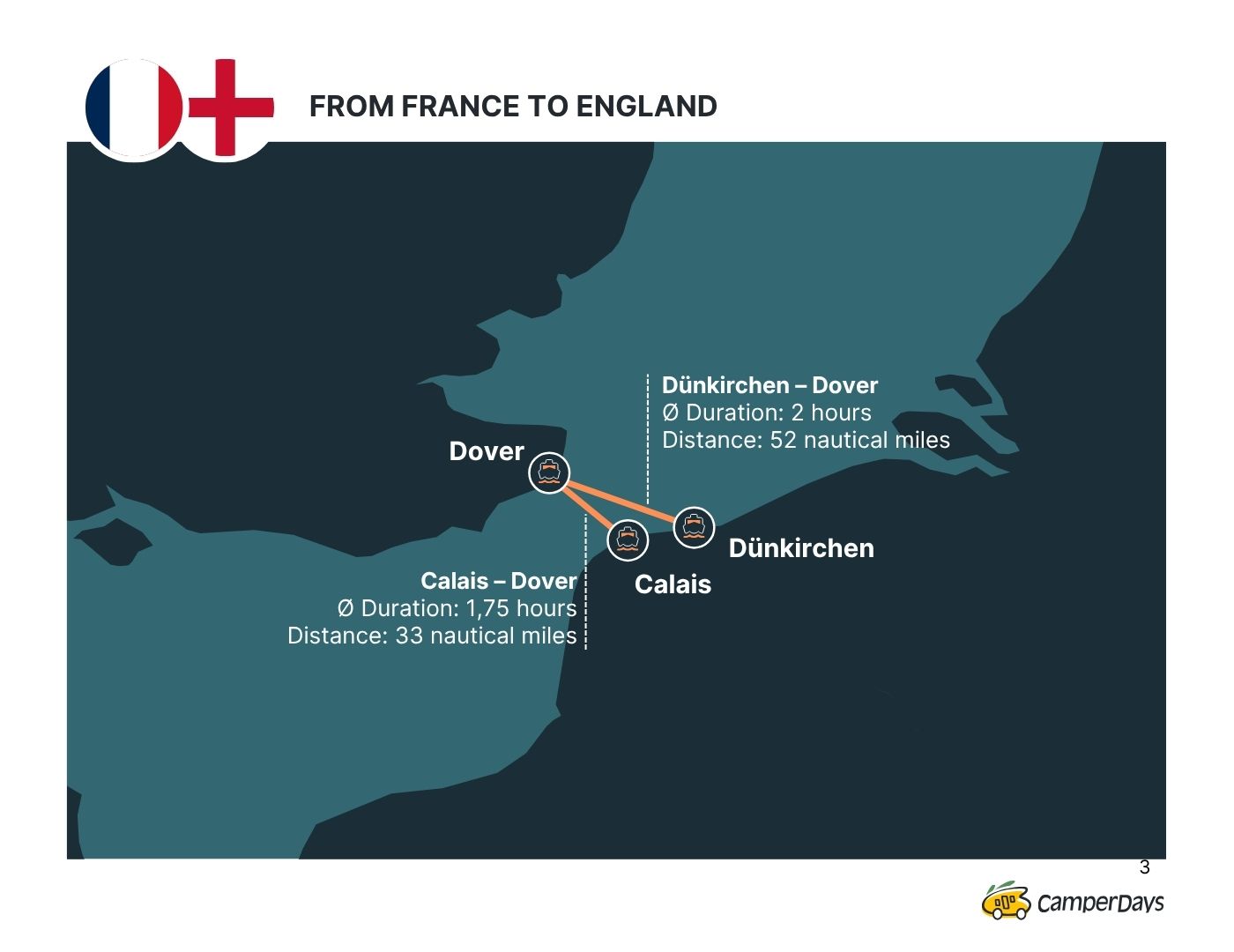
Calais – Dover
The ferry trip between Calais and Dover is by far the shortest connection of the routes examined. The crossing takes around 90 to 100 minutes and runs very frequently.
Travel time: approx. 1 hour 40 minutes
Average departures: up to 25 crossings per day
Average campervan price (return trip, 2 people): € 375
The short travel time makes the Calais – Dover connection extremely flexible. Since there are numerous departures per day, the crossing can easily be integrated into individually planned round trips.
Dunkirk – Dover
The Dunkirk – Dover route also connects France with southern England. The crossing takes about two hours and is offered several times a day.
Travel time: approx. 2 hours
Average departures: up to 9 crossings per day
Average campervan price (return trip, 2 people): € 355
Dunkirk can be a suitable alternative to Calais as a port of departure or arrival and, depending on the season, offer cheaper crossings.
Ferry travel between Wales and Ireland
With its extensive rolling hills and rugged coastlines, the Emerald Isle of Ireland is a particularly scenic destination for campervan trips. The ferry routes from Great Britain to Ireland create a convenient connection between the two islands.
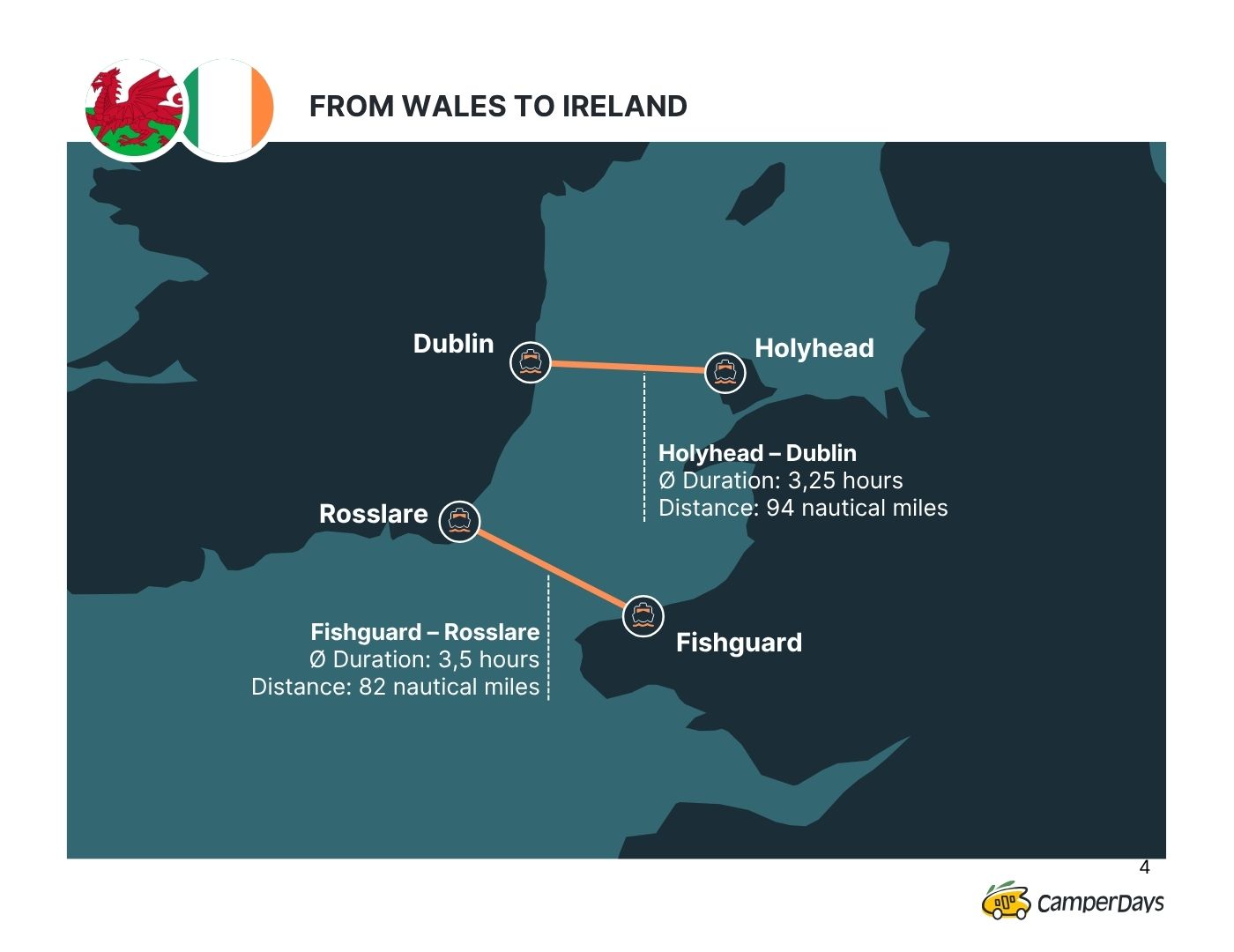
Holyhead – Dublin
The ferry route between Holyhead and Dublin is one of the most important ferry connections between Great Britain and Ireland. The crossing takes about three hours and 15 minutes. The ferries depart on average five times a day.
Travel time: approx. 3 hours 15 minutes
Average departures: up to 35 weekly crossings
Average campervan price (return trip, 2 people): € 625
This crossing is interesting for all travellers who do not want to miss out on a trip to the capital of the Republic of Ireland.
Fishguard – Rosslare
Another direct connection between Wales and Ireland is available via Fishguard – Rosslare. The crossing takes about three and a half hours and is offered around twice a day.
Travel time: approx. 3 hours 30 minutes
Average departures: up to 13 weekly crossings
Average campervan price (return trip, 2 people): € 635
The route differs only slightly in price from Holyhead – Dublin. However, this connection can be the more practical port choice if travellers mainly want to explore the south-eastern regions of the country.
Conclusion: By campervan via ferry through Europe – an overview of the pros and cons
Ferry trips are a practical way to extend camping holidays in Europe, especially if they shorten long drives or provide direct connections to your desired destination. Anyone travelling with their own or rented campervan remains flexible and avoids having to search for a rental vehicle on site. We have briefly summarised the most important arguments for and against taking a ferry below.
Pros:
More comfort on long routes: Instead of driving for many hours yourself, travellers can use the crossing to eat, rest or spend relaxing time with the family. Moreover, there is greater freedom of movement on board than, for example, on a plane or during long car journeys.
More storage space for personal belongings: When travelling by campervan, the amount of luggage you carry is less important than when flying, as ferries do not have strict weight and size limits for luggage. This makes packing for longer road trips significantly less challenging.
Lower travel costs: A ferry ticket for the whole family can sometimes be cheaper than flights for every family member plus rental car and accommodation costs at the destination.
Direct access to destinations: Travellers can reach islands like Sardinia directly with their own campervan from the mainland. In addition, the route to the ferry can already be incorporated into your holiday to discover interesting places along the way.
Cons:
High costs for long crossings: Depending on the route, vehicle size and number of people, prices can increase significantly. For night ferry trips, booking a cabin may result in additional costs.
Short holiday time: For short stays, a long ferry crossing can be impractical in relation to the amount of holiday time. For city breaks or short trips, a flight combined with a rental car may be the better solution.
Vehicle size affects the price: The length and height of the campervan can dictate the fare class and thus the ferry price. Especially with large campervans, ferry prices can skyrocket.
Not every route is suitable for rented campervans: Travellers should check before booking whether the rental company permits a planned border crossing. Especially for trips to or from the United Kingdom or Ireland, additional permits or insurance may be required.
How much does a ferry trip with a campervan cost?
For the shown average prices of a specific ferry route, we based our calculations on typical travel scenarios. Individual circumstances can of course influence the pricing. The following five factors are particularly relevant here:
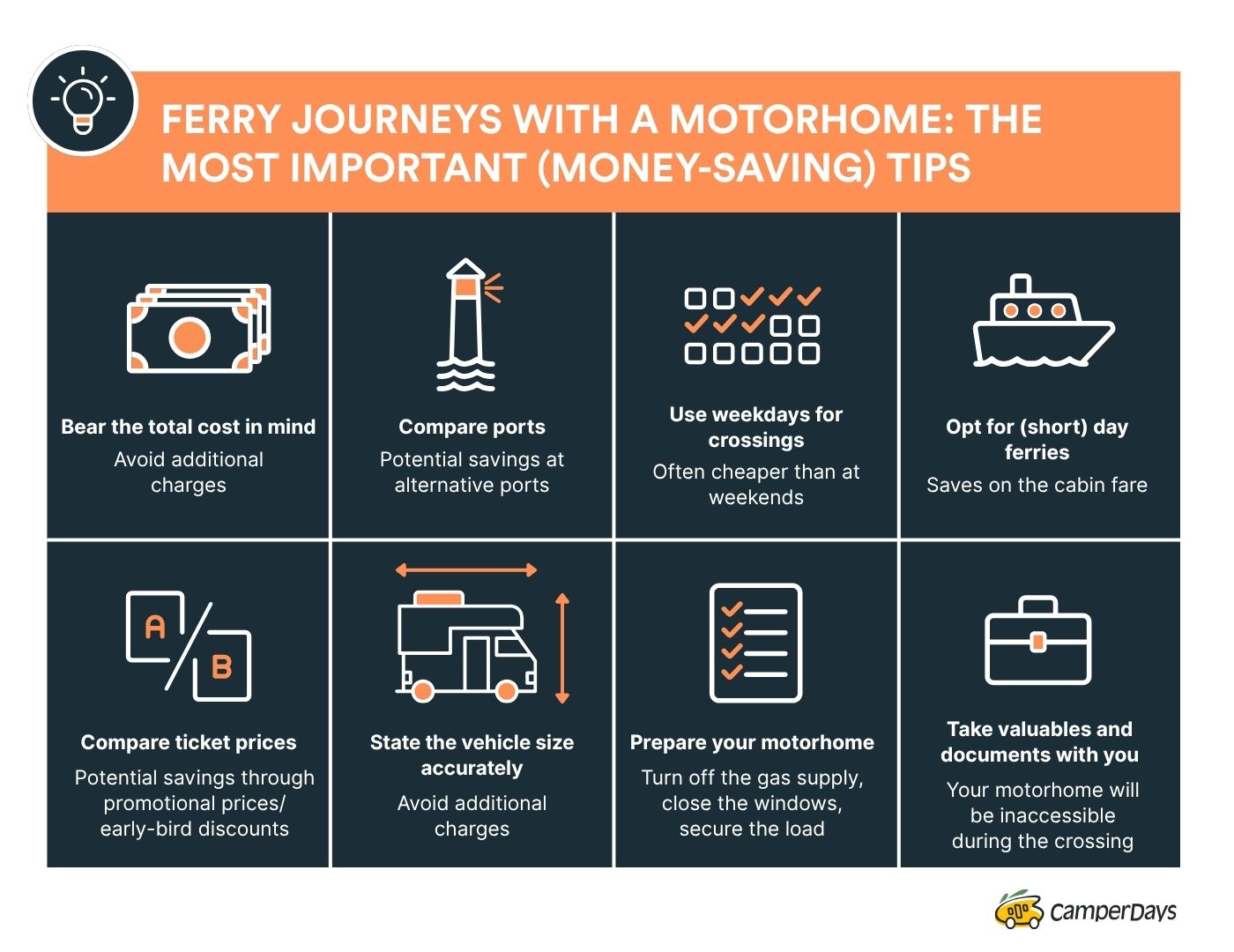
Vehicle length and height: A compact panel van under six metres long can be significantly cheaper than a seven- or eight-metre-long campervan. Therefore, the actual vehicle size, including all attachments, must be specified when booking.
Number of travellers: Ferry prices are often made up of a combination of vehicle and passenger fares. An average value for one person is therefore not automatically representative of a family of four: a ferry trip can actually be cheaper per head the more people travel.
Travel period and day of the week: Holidays, weekends and high-demand departures can be significantly more expensive. Those who are flexible with their travel dates have a better chance of finding cheaper fares.
Time of booking: Ferry prices are dynamic. A currently shown average price is therefore only a snapshot. Booking early is particularly sensible for popular holiday periods and long crossings.
Additional services: These include, for example, the cost of taking a pet, booking a cabin or extra costs for attachments to the vehicle (e.g. bicycle carriers).
Taking a ferry trip with your campervan – further tips for camping holidaymakers
When going on a ferry trip with a campervan, there are a few practical points to consider aside from choosing the right route. Good preparation can help make the crossing hassle-free – from booking to boarding.
Specify the vehicle size exactly when booking
When booking, travellers should specify the exact dimensions of their campervan. Length, height and weight are decisive for which parking space is available on the vehicle deck and which fare applies. Bicycle carriers, roof boxes or other attachments must also be taken into account for the overall dimensions.
Jeanette, Customer Service (CamperDays): "Many customers ask themselves: 'What should I do about the number plate, I don't even know it yet?' We always reassure them: just enter a placeholder when booking! You can then easily add the real number plate on the day of departure directly at the ferry port."
Plan and book early
Especially in the peak season, the demand for spaces for larger vehicles is very high. Early planning is therefore sensible if you want to have the widest possible choice of departure times and, if necessary, cabins.
Prepare your campervan for the crossing
Travellers should prepare their vehicle for the crossing before boarding. This includes securing loose objects, closing windows and turning off the gas supply according to the regulations. Special transport regulations may also apply to gas bottles, camping stoves, generators or extra fuel containers.
Campervan is inaccessible during the crossing
For safety reasons, you are not allowed to stay in your campervan during the ferry crossing. Travellers must therefore stay on deck or, for longer crossings or night trips, in a cabin. Travellers should take identification documents, vehicle papers and proof of insurance on board with them and not leave them in the campervan. Since the vehicle deck is inaccessible during the crossing, camping holidaymakers should also take medication, valuables and other personal belongings with them before leaving their vehicle.
Allow enough time for check-in and boarding
For ferry trips with a campervan, you should allow plenty of time for the journey to the port, check-in and boarding. At some ports, there are separate procedures for larger vehicles. If you adhere to the specified check-in time and have the necessary documents at hand, you can avoid delays when boarding.
Excursus: Campervan travel between the United Kingdom and the EU
Since the United Kingdom left the European Union, spontaneous entry is no longer possible for EU citizens. Anyone planning a camping holiday in England, Scotland, Wales or Northern Ireland must therefore comply with the current entry requirements. For German tourists, the following points are generally relevant:
Holidaymakers generally need a valid passport to enter the United Kingdom. The German identity card is not sufficient for normal tourist travel. The Federal Foreign Office explicitly points out that this also applies to transit passengers.
For tourist trips from 2025 onwards, it is also mandatory to apply for an electronic travel authorisation, provided no visa or other residence permit is held. The Electronic Travel Authorisation (ETA) is personal to the individual. If four people are travelling in the campervan, you will generally need four corresponding travel authorisations. Germans who also hold British or Irish citizenship do not need an ETA and can enter with their British or Irish passport.
Jeanette, Customer Service (CamperDays): "A topic we often discuss on the phone is travelling to other European countries – especially when taking the ferry to Great Britain or Ireland. Many people are aware of the entry requirements, but with a rented campervan, you also always have to check what the rental company says about it. Most of the time, such non-EU trips are no problem at all! The only important thing is that you often have to state it when booking or get it briefly approved. Sometimes a small insurance upgrade is also needed. Our tip is always: clarify this and briefly check the rental conditions before firmly booking the ferry. This saves a lot of stress on the road."
Methodology and data basis
We based all price examples on a uniform travel scenario with two people. The assumed vehicle size for the country-specific travel scenarios is based on the actual booking behaviour of CamperDays customers.
For trips to Sweden and Norway, semi-integrated campervans are booked particularly often. For the corresponding ferry connections, a vehicle with an average length of 7.6 metres and a height of 3.0 metres was therefore assumed.
For trips in France, Great Britain, Ireland and Italy, however, panel vans are booked particularly frequently. For ferry trips in these countries, a vehicle with an average length of 6.5 metres and a height of 2.6 metres was therefore assumed.
This booking data was used to determine a typical travel scenario for the respective destination.
The average ferry prices were researched on booking and price comparison portals. Both travel dates in the peak and off-peak season 2026/2027 as well as last-minute dates were taken into account for the ticket prices.
The actual ticket costs depend on, among other things, the length and height of the vehicle, the number of people travelling, the travel date, the departure time and additional services. The previously defined vehicle dimensions were therefore taken into account during the research, provided the respective source enabled corresponding price differentiation.
The determined prices reflect a potential price range and can serve as a guide. Many shipping and ferry companies work with dynamic fares, meaning that the actual amount payable can vary depending on the travel and booking dates, season and capacity. The determined average prices are not to be understood as binding offers.
The report therefore makes no claim to the timeliness, completeness or flawless accuracy of the data.