
CamperDays Study: How affordable are motorhome holidays in Europe?
Vast, unspoiled landscapes make Northern European countries an ideal destination for extensive road trips. If you want to travel as flexibly as possible and cover greater distances, you need to ask yourself an important question when planning your trip: is a motorhome tour worth it, or is a combination of hotel stays and a local rental car the better choice? Both types of travel differ fundamentally in terms of comfort, flexibility, and travel costs.
The aim of the study is to find out which of the two travel options is more affordable when taking all relevant costs into account. As pricing structures vary greatly depending on the season (especially in Northern Europe), we have looked at and evaluated the high and low seasons separately.
Our methodology
For our analysis, we focused on a direct cost comparison of rental prices and accommodation costs incurred during a road trip. We also included factors such as fuel consumption in the evaluation. The resulting comparative values not only provide a reliable insight into the average pricing of both travel options, but also allow us to derive some general money-saving tips.
In our evaluation, we focused on four popular travel destinations and camping countries in Europe: Iceland, Sweden, Norway, and Germany. We analysed the travel duration, the distance driven, and the average costs for vehicle rental and accommodation. These values result in a representative total price for the high and low season. This consists of:
Vehicle costs: average daily rental prices for the most frequently booked motorhome and rental car models in the respective destination country (including commonly booked extras such as a sat nav or basic insurance options)
Accommodation costs: average prices for a double room in a 3-star hotel or pitch costs at campsites with water and power supply
Fuel costs: calculated based on the average distance travelled, average fuel prices (petrol and diesel, 2025-2026), and the average consumption of the most popular vehicle models
You can find more information about our database and methodology at the end of this study.
Sweden
With its vast forests and numerous lakes, Sweden is one of the most picturesque destinations for a road trip in Europe. The combination of closeness to nature and reliable infrastructure particularly appeals to holidaymakers who want to travel away from mass tourism. The Scandinavian country is particularly well-suited for a motorhome holiday due to its vast landscapes and numerous well-equipped campsites.
On average, CamperDays customers travel through Sweden by motorhome for 14 days. On their travels, they cover an average of 1,500 kilometres to thoroughly explore the Scandinavian country. Touring Cars is the most requested rental company. Customers particularly often chose the "TC Medium" (for up to four people) and "TC Van" (for two people) models.
Ø Travel duration: 14 days
Ø Distance: 1,500 km
Ø Diesel price: € 1.52 / litre
Ø Petrol price: € 1.44 / litre
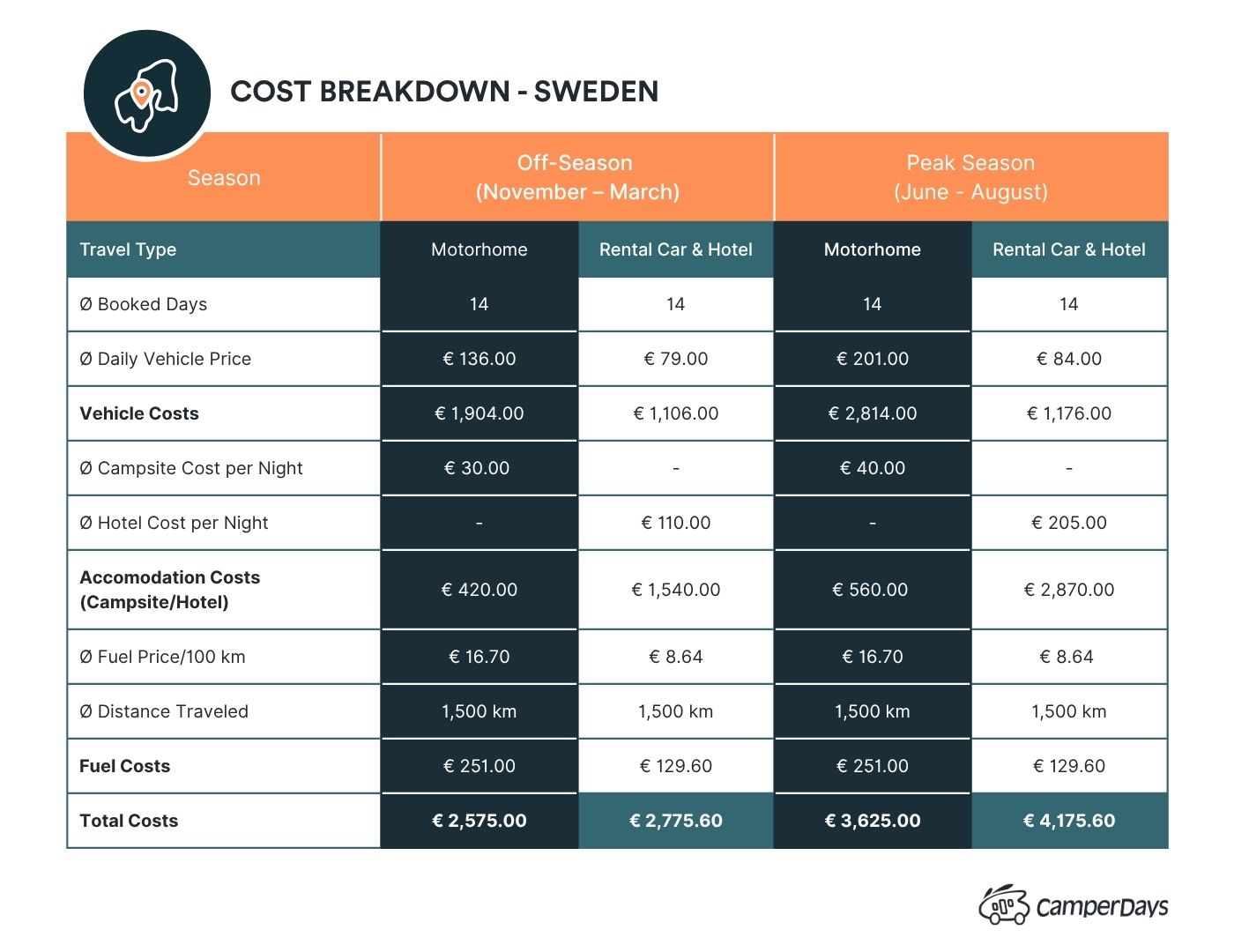
In the low season, the costs for a motorhome holiday and a trip with a rental car and hotel in Sweden differ by about 8%. In the high season, there are even clearer price shifts: a motorhome holiday is then on average around 13% cheaper than the combination of hotel stays and a rental car. Although the daily rent for motorhomes increases by about 30% during this time, hotel prices almost double in the same period. Rental car prices, on the other hand, remain relatively stable and show only minor seasonal fluctuations.
Additional savings opportunities arise for motorhome holidaymakers if they book a pitch at simply equipped campsites instead of higher-priced holiday and resort camping facilities. Since popular motorhome models like the "TC Medium" have their own kitchen and a bathroom with a toilet and shower, travellers still do not have to sacrifice comfort on the road. Sweden is particularly recommended for travellers who value nature, peace, and outdoor activities. The good availability of nature-close pitches makes the country an attractive destination for flexible and individually planned road trips, which are particularly comfortable in a motorhome.
Norway
Norway is known for its dramatic landscapes with fjords, striking mountain ranges, and impressive panoramic roads. Motorhome holidaymakers primarily benefit from the opportunity to stay overnight in remote regions and enjoy the view directly from the vehicle.
On average, CamperDays customers take about 12 days to explore Norway and cover around 2,000 kilometres. The most frequently booked motorhome models are the "Family Standard" (suitable for up to 4 people) and the "Urban Plus" (ideal for 2 people) from the rental company McRent.
Ø Travel duration: 12 days
Ø Distance: 2,000 km
Ø Diesel price: € 1.69 / litre
Ø Petrol price: € 1.76 / litre
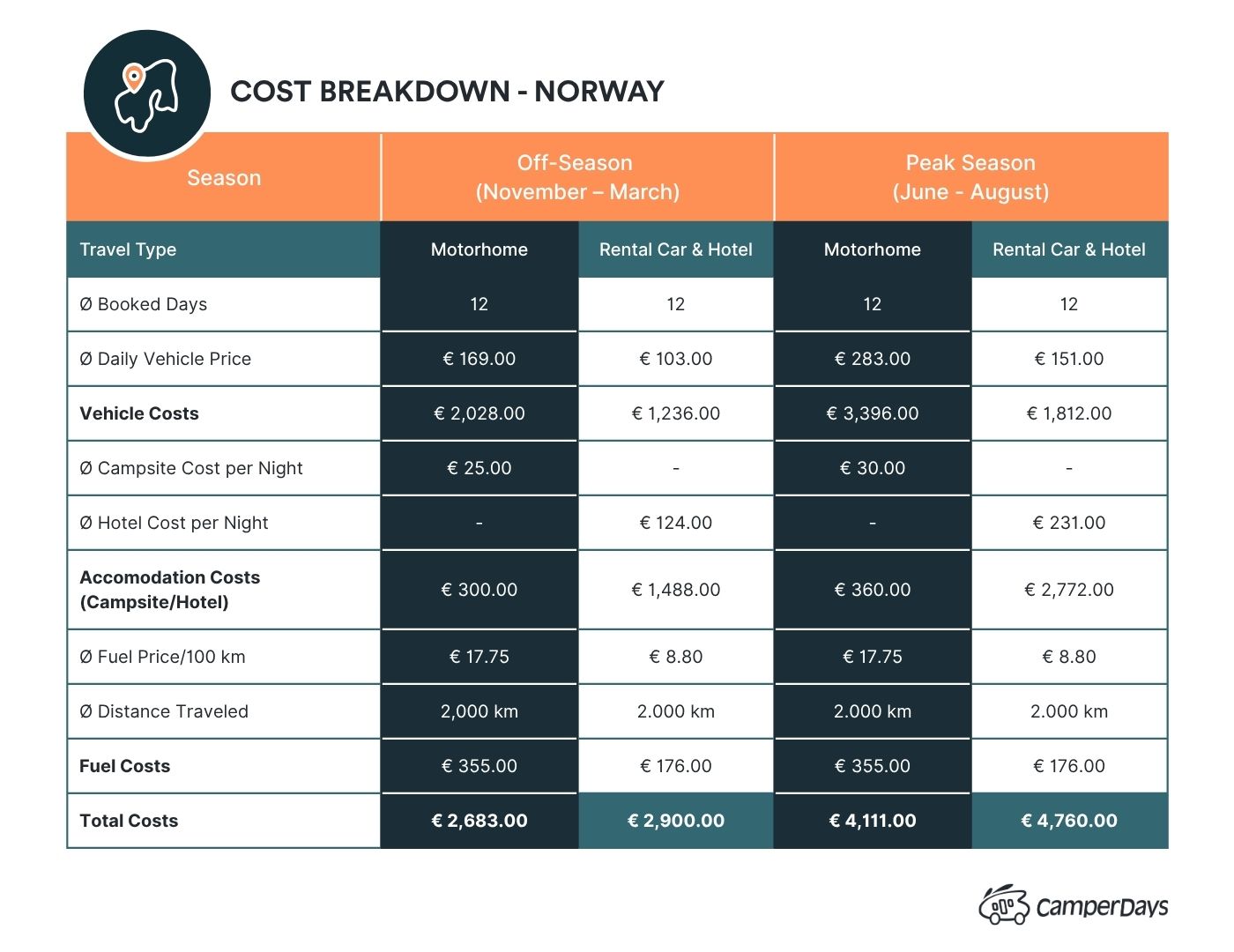
In Norway, motorhome holidaymakers save about 8% in the low season compared to a rental car trip with hotel stays. In the high season, there is an even clearer advantage in favour of the motorhome: a camping holiday is then on average around 14% cheaper. Although the prices for rental motorhomes increase by up to 40% in the popular travel season, hotel prices also rise by about 46% and rental car prices by around 32%. Overall, the motorhome therefore still remains the more affordable option.
Further savings opportunities arise if motorhome holidaymakers cater for themselves and switch to simply equipped pitches. Norwegian campsites are often located in scenic surroundings, in the immediate vicinity of fjords, mountains, lakes, or beaches, and are therefore particularly attractive to nature fans and outdoor sports enthusiasts. At the same time, the density of campsites in urban areas is also high enough that city trips are easily possible.
Iceland
Iceland stands for wild landscapes and spectacular natural phenomena, which can be experienced particularly intensely along easily accessible routes such as the famous "Ring Road". Sulphur springs, glaciers, waterfalls, and lava fields are often only a few minutes' drive apart. Motorhome travellers benefit from high flexibility, as Iceland offers a reliable camping infrastructure despite its remoteness.
On average, CamperDays customers book a motorhome in Iceland for 10 days and cover around 1,800 kilometres. The most frequently booked motorhome models are the "TC Medium" from Touring Cars and the "Family Standard" from McRent, both of which are suitable for up to 4 people. Another popular model is the "Cheap Campervan" from the Icelandic rental company of the same name, which offers space for 2 adults.
Ø Travel duration: 10 days
Ø Distance: 1,800 km
Ø Diesel price: € 2.16 / litre
Ø Petrol price: € 2.04 / litre
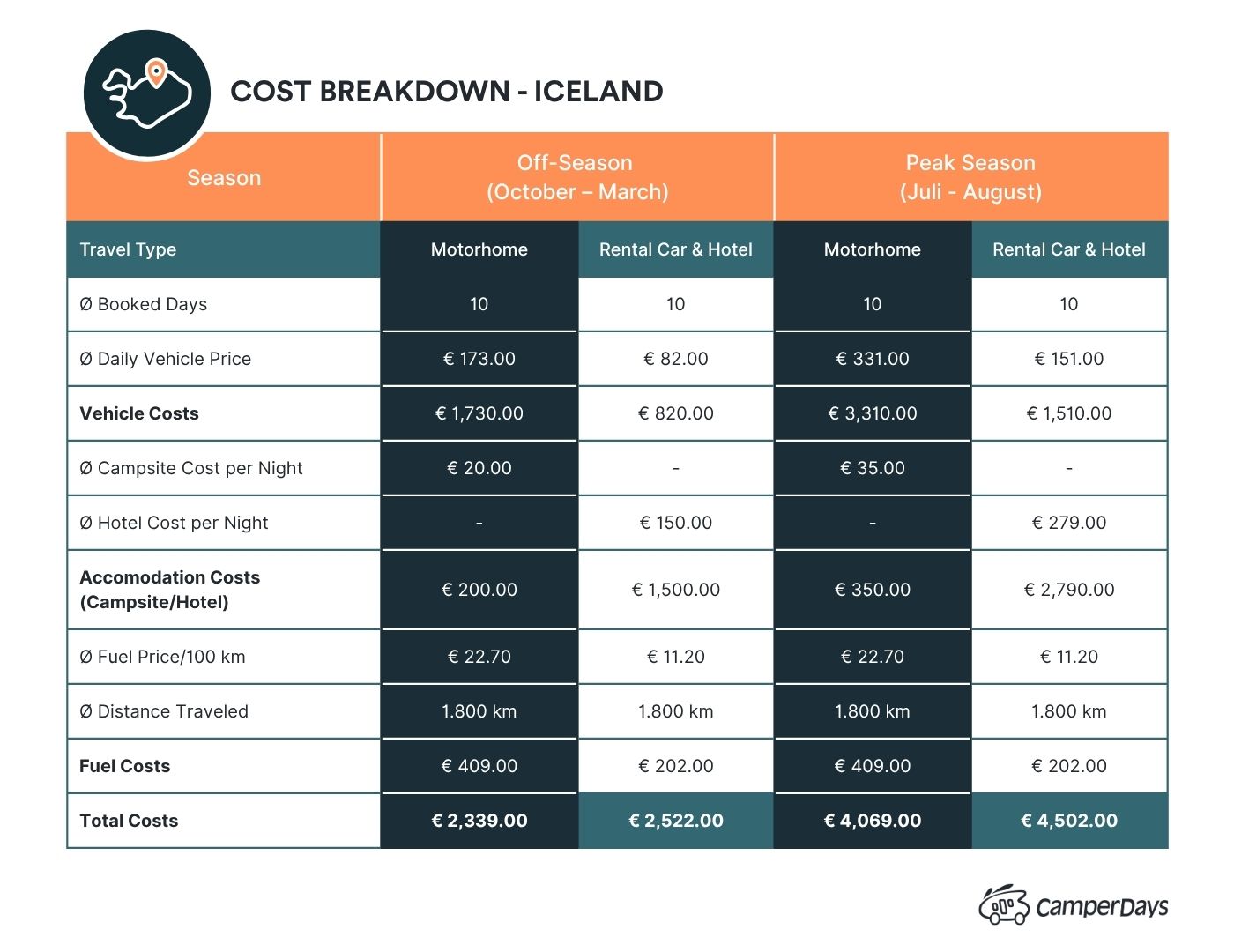
Iceland records significantly higher costs in the high season than in the low season for both forms of travel. Both motorhome rentals and hotel prices rise sharply in the most popular travel season, in some cases doubling. Rental cars are also noticeably more expensive in the high season. Despite these general price increases, a motorhome holiday in Iceland remains on average about 10% cheaper than the combination of hotel and rental car.
For longer stays, motorhome holidaymakers can save even more, for example by using the Iceland Camping Card, which offers access to a variety of campsites at a fixed flat rate. A road trip by motorhome also allows for a greater degree of flexibility and comfort on the island. This allows holidaymakers to choose their overnight locations spontaneously and reach the scenic highlights (e.g. along the 1,322-kilometre-long Ring Road) in a particularly relaxed manner, without having to check in and out of different accommodations every day.
Germany
Germany is characterised by remarkable scenic and cultural diversity, which holidaymakers can explore over comparatively short distances. Whether coastal stretches on the North and Baltic Seas, low mountain ranges like the Harz or Black Forest, or the Bavarian Alps – the Federal Republic is suitable for motorhome fans for both shorter trips and longer round trips.
On average, CamperDays customers holiday in Germany for 14 days and drive around 900 kilometres. McRent is the most frequently chosen rental company; the most popular models are the "Standard McRent" for up to 4 people and the "Urban Plus" for 2 people.
Ø Travel duration: 14 days
Ø Distance: 900 km
Ø Diesel price: € 1.61 / litre
Ø Petrol price: € 1.69 / litre
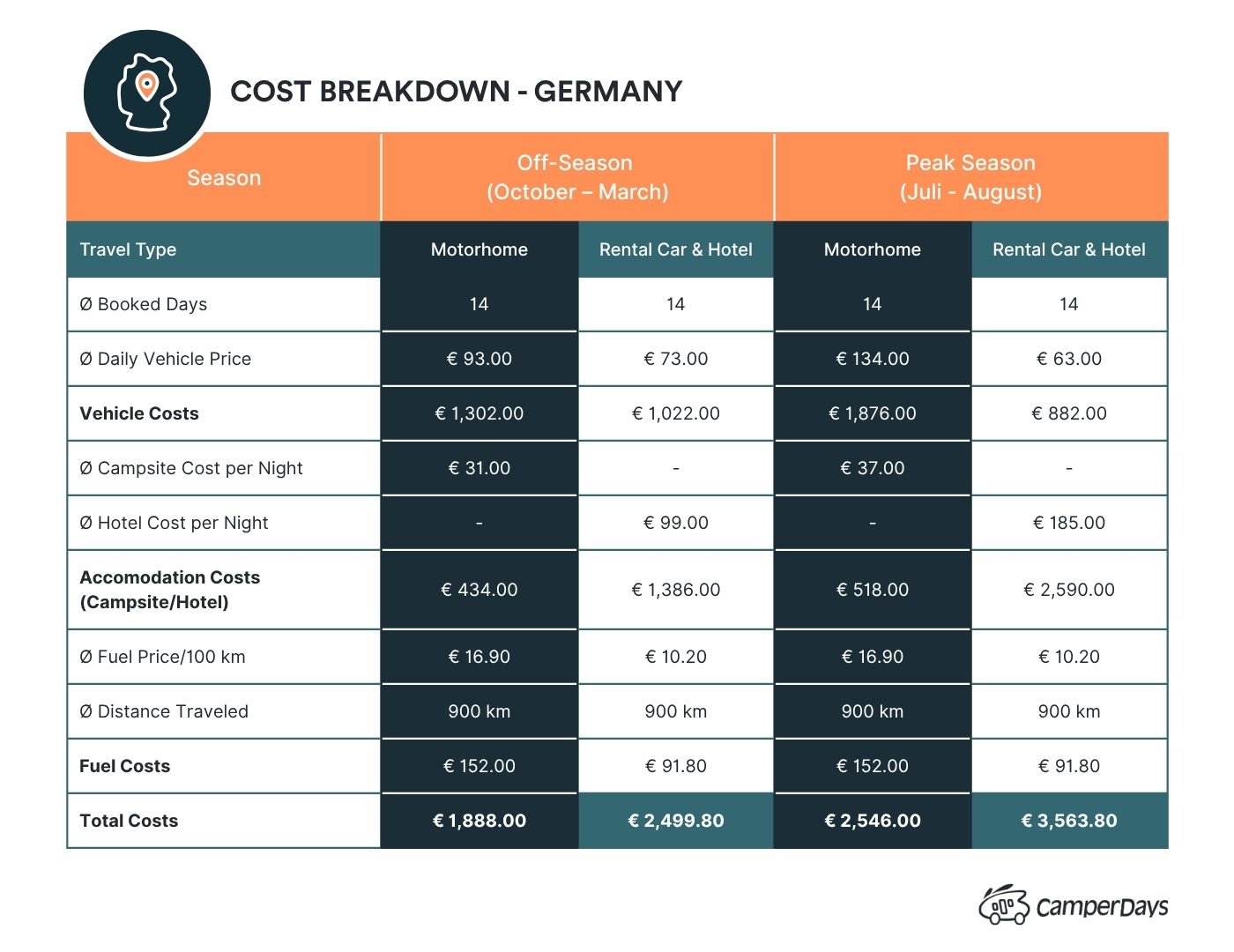
In Germany, a motorhome holiday is the cheaper option in both the low and high seasons. In the low season, costs are on average 24% lower, and in the high season around 29% lower, than a trip with a rental car and hotel stays.
It is noticeable that rental car prices in Germany are sometimes even slightly lower in the high season than in the low season. A possible reason for this is that many German holidaymakers use their own cars for domestic travel and the demand for rental vehicles (e.g. for business trips) is slightly lower in the summer months. It is all the more remarkable that motorhome travel remains the more affordable form of travel despite this development.
Conclusion: a camping holiday in Northern Europe is also worthwhile in the high season
Road trip by motorhome or hotel holiday with a rental car – which is cheaper? As our study shows, travelling by motorhome in the popular Northern European countries and Germany offers significant potential savings in both the low and high seasons. At the same time, travellers on a road trip in a motorhome benefit from a high degree of flexibility and comfort. Since accommodation and transport are combined, long distances can be covered comfortably without frequent hotel changes. Especially in expansive destinations like Norway, Sweden, or Iceland, this form of travel proves particularly practical and enables unique, nature-close travel experiences.
The following findings can also be derived from our analysis:
Largest price difference between high and low season: Iceland is a true paradise for an extended camping trip, which is why the demand for motorhomes rises sharply in the high season. Compared to the low season, prices almost double. Rental car and hotel costs also rise sharply during this period. For motorhome holidaymakers, booking early is therefore highly recommended to benefit from a larger selection of motorhomes and the best prices.
Greatest savings potential: In Sweden and Norway, motorhome holidays in the high season are on average around 15% cheaper than the combination of a hotel and rental car. Those who opt for a camping holiday in Germany instead of hotel stays and a rental car can save up to 29%.
Motorhome as the most comfortable option for road trips: Thanks to their vast, untouched landscapes, the Northern European countries are wonderfully suited for road trips. Holidaymakers in Norway, Sweden, and Iceland cover distances of at least 1,500 and 2,000 kilometres over periods of up to 14 days. With a rented motorhome, holidaymakers can concentrate entirely on their daily experiences without having to switch between different accommodations.
Notes on the CamperDays comparative study | Northern Europe & Germany
All data listed in this analysis are to be understood as average values and make no claim to be error-free. Price deviations upwards or downwards are possible depending on the size of the travel group, length of stay, and other individual aspects of travel planning (e.g. facilities at campsites or different room categories in hotels).
Accommodation costs particularly influenced the overall budget. For the data collection, we focused on standard double rooms in mid-range hotels as well as campsites with power and water supplies.
In order to examine various cost items and potential savings in more detail, we will explore different travel scenarios below.
Possible travel scenarios
In this study, prices for trips with two people were determined based on our average booking data.
However, since many popular motorhome models offer sleeping spaces for up to four people, the rental price can be split among several people for group trips. The more (adult) people travelling, the cheaper the motorhome holiday is.
This results in various typical configurations for larger campers:
Two adults
Two adults with one child
Three adults
Four adults
Two adults with two children
The better holidaymakers utilise the capacity of the motorhome, the more the costs per person decrease. Families and smaller groups in particular benefit from this. Especially for three or four adults, a joint motorhome trip can be financially considerably more attractive than the hotel alternative, where several rooms would usually be required.
Further cost aspects and savings potential
For both forms of travel, there are further potential savings if holidaymakers switch to cheaper accommodations. Those travelling with a rental car can opt for hostels or simple motels, for example.
Motorhome holidaymakers can save equally by choosing more simply equipped pitches. Many campsites offer facilities that significantly increase comfort during longer stays, such as on-site leisure and wellness options. Simpler, nature-close campsites are often much cheaper and are ideal as stopovers for extended road trips.
Lower food costs are also among the key advantages of a motorhome holiday. Thanks to the vehicle's own kitchen, holidaymakers can prepare their meals themselves and do not have to rely on restaurants or hotel catering. In many European travel destinations where restaurant visits or half and full board in a hotel can quickly become expensive, a noticeable part of the travel budget can be saved through self-catering.
In addition to accommodation and vehicle costs, there are other associated costs that are too individual to be included in these calculations. These include factors such as toll charges or parking fees on city trips. Furthermore, early bird offers or last-minute discounts can influence the total costs. Those who reserve early generally benefit from lower prices – both for hotels and motorhomes.
Further decision-making criteria
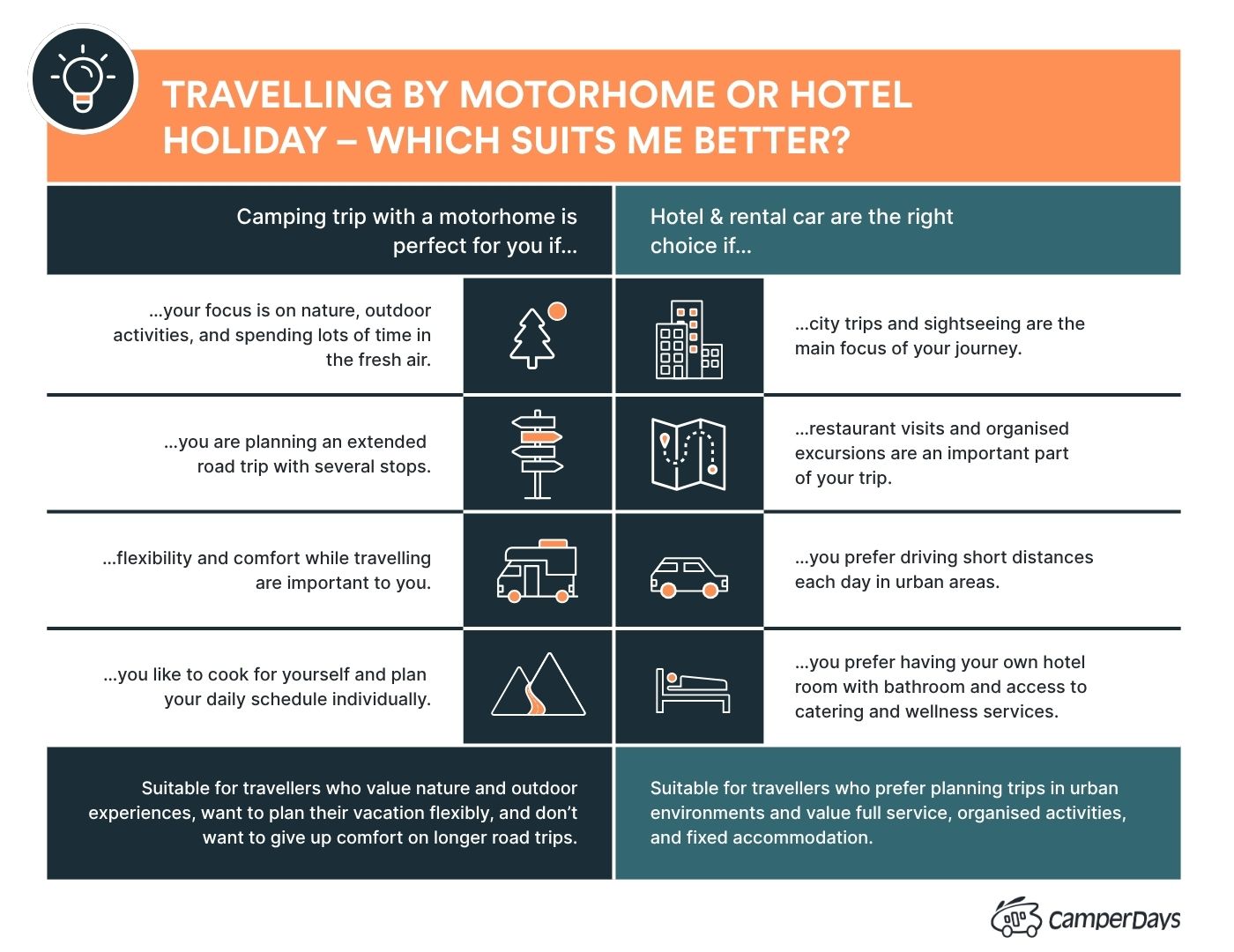
Whether holidaymakers decide on a camping trip or a hotel holiday naturally does not depend solely on the cost structure. Personal preferences and demands for comfort and flexibility naturally play a central role in choosing the appropriate form of travel.
A motorhome trip is particularly suitable for people who want to spend a lot of time outdoors, often change their plans spontaneously, enjoy cooking for themselves, or want to travel together as a family or small group. Staying in a camper allows for immediate closeness to nature and a high level of independence in planning routes and daily schedules. For road trips where large distances are to be covered in a specific destination country, motorhomes are the most comfortable and uncomplicated option.
Conversely, the combination of hotel stays and a local rental car may be better suited if city trips are the focus of travel planning or holidaymakers want to stay in the same region for a longer period. Those who often travel in cities for sightseeing and cultural activities and want to be mobile there are often better advised with a car and fixed accommodations.
Our data basis
For a clean, comparable cost analysis, all data was systematically collected and evaluated separately according to high and low season. The values represent typical price levels in tourist-relevant regions of the four countries examined.
Accommodation costs
For each country, 50 hotel prices were evaluated for both seasonal phases. Accommodations in different cities and regions were taken into account to reflect a realistic price level in the nationwide average. In addition, we used international price comparison platforms such as budgetyourtrip.com, where users document their realistic travel costs.
For campsites, 40 locations per country and season were examined (depending on availability). In doing so, we focused on locations with basic facilities. For countries with limited data, random price comparisons were made and developments were interpolated based on similar markets.
Vehicle rental prices
Rental prices for motorhomes and cars were calculated based on 100 offers per country as well as the average monthly prices in the three largest cities of the respective country. We took the most popular vehicle models in the most visited cities into account. Additionally, we included random samples from different months of the high and low season to map seasonal price fluctuations realistically.
Fuel costs
The calculation of fuel costs is based on reported average prices over the last 12 months for petrol and diesel. For motorhomes, the average consumption of the most popular models in the respective market was applied, and for rental cars, an average over common vehicle classes was determined.
This broad data collection allows for a differentiated assessment of the total costs – both within the individual countries and in a direct comparison between the two forms of travel. However, the study makes no claim to the completeness or flawless accuracy of the data.